
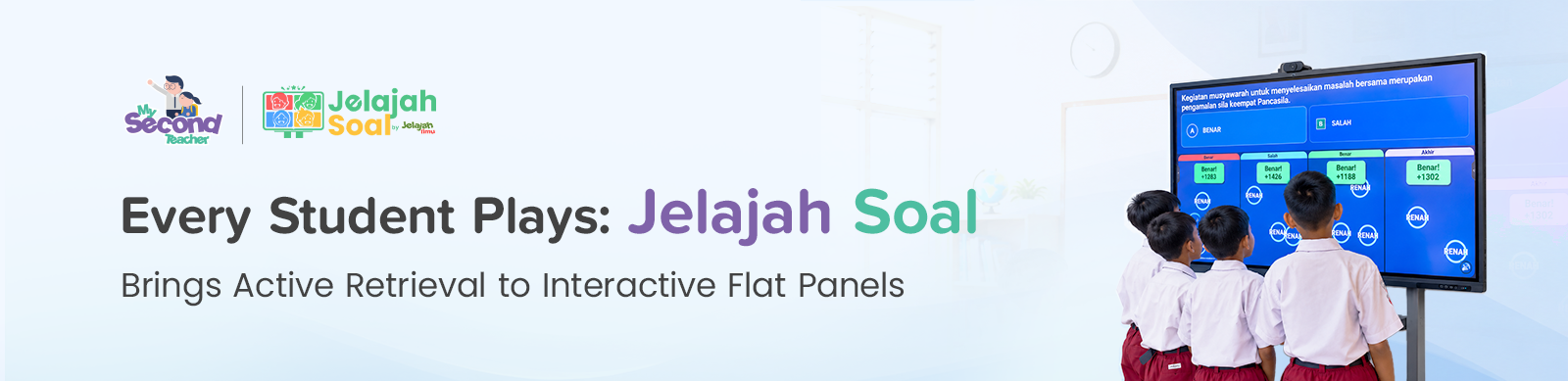
Every Student Plays: Jelajah Soal Brings Active Retrieval to Interactive Flat Panels
Blog published on August 17, 2026 • By mySecondTeacher



In most classrooms, a quiz is a solo activity. A question goes up, one student answers, and the rest of the room waits. The students who most need the practice are often the ones who stay quiet, and a teacher can finish a revision session without ever learning what the majority actually understood.
Digital quizzing was meant to solve this, but it introduced a requirement of its own: a device in every pair of hands. In schools where one-to-one devices are not a given, that requirement quietly excludes the very classrooms it was designed to help. The interactive flat panel at the front of the room, meanwhile, already installed, already switched on, is used as a screen to be looked at rather than a surface to be played on.
MST/Jelajah Ilmu has released a tool built around that panel. Jelajah Soal turns a single classroom display into a multiplayer game surface, so that two to four students compete on the same question at the same time, no student accounts — no student devices, and nothing for a child to log in to.
Learning through Active Retrieval
The pedagogy underneath it is Active Retrieval Practice — the well-evidenced finding that recalling information strengthens memory more effectively than reviewing it. A student who retrieves an answer under mild pressure remembers it longer than a student who reads the same fact a second time. Retrieval turns assessment into instruction rather than a measurement taken afterwards.
Retrieval practice works best when it is frequent, low-stakes, and answered by everyone rather than by whoever raises a hand first. That last condition is the one classrooms find hardest to meet, and it is the condition Jelajah Soal is designed around: every player answers every question, every round.
What is Jelajah Soal?
Jelajah Soal (available in English as ClassClash) is a browser-based quiz game for the classroom panel. Teachers write quizzes on their own device — with AI assistance or by hand — and publish a six-character class code. At the panel, students type the code, choose how many are playing, and the panel splits into two, three, or four lanes.
The same question appears in every lane simultaneously. Everyone answers; the fastest correct answer earns the most. There are no student accounts at any point, so no personal data is collected from children, and a class can start playing in seconds.
How does Jelajah Soal work?
The teacher authors a quiz. Questions can be generated with AI assistance from a topic and grade level, or written manually. The teacher always reviews and approves the content before it can be played.
The teacher publishes a class code. Each quiz carries one six-character code, which the teacher switches on and off as needed. The code can be printed on a worksheet or written into a lesson plan and reused next term.
Students enter the code at the panel. No login, no account, no device of their own. The panel divides into a lane for each player.
Everyone answers every round. The question appears in all lanes at once. Correct answers score, faster correct answers score more, and a running scoreboard keeps the room engaged between questions.
The correct answer is revealed to the class. Each round closes by showing what the right answer was — the moment where a quiz becomes a lesson rather than a score.
Two ways to play
Classic Quiz is the familiar format: read the question, tap the answer. It ships with eight visual styles and two rule structures, so the same content can be replayed as a different-feeling game across the term.
Answer Ninja (Ninja Penjawab) inverts the task. Each lane fills with tokens carrying every answer option, and players slash away the wrong ones. When only one option remains in a lane, that is the player's answer.
The design turns on a single observation: if you know the answer is C, you can slash everything else without hesitating; if you don't know, you cannot slash safely at all. Knowledge stops competing with dexterity and starts enabling it. A student who knows the material clears their lane quickly and confidently; a student who is guessing must stop and think before every swipe, and the clock does the rest.
It also rehearses something students need anyway. Elimination is how candidates are taught to approach multiple-choice examinations — rule out what cannot be right, then decide. Answer Ninja drills that habit as a game mechanic rather than as advice.
What teachers found in the classroom
Jelajah Soal has been running with teachers in Indonesian schools through a closed pilot, and the platform was rated 4.83 out of 5 for enjoyment, 5.00 for ease of use, 4.67 for question quality, and 4.70 overall.
The more telling result sits underneath those scores. Every quiz in the pilot was authored in Indonesian, and teachers published the AI-generated questions without editing them. Subject specialists accepting first-draft output in their own language, at that rate, is a stronger endorsement than a satisfaction score.
Both features released since — a longer round timer for Answer Ninja, and the end-of-round answer reveal — came directly from watching students play, not from the product team (see: https://www.youtube.com/watch?v=MVUjbjDfpeU)
How to use Jelajah Soal effectively
Use it for revision, not first teaching. Retrieval practice strengthens what students have already met. The strongest use is at the end of a topic or the start of the following lesson.
Run short, frequent rounds. A five-minute game several times a week does more for retention than one long session before an examination.
Rotate every student through the panel. The benefit comes from retrieving, not from watching. Keep groups small and the turns moving so the whole class plays.
Pause on the reveal. When the correct answer appears, ask the room why the other options were wrong. This is where the pedagogical value is highest and it costs thirty seconds.
Introduce Answer Ninja deliberately. Tell students plainly that they are removing the wrong answers, not hunting the right one. It is a counterintuitive instruction, and classes that hear it clearly enjoy the game immediately.
Reuse your codes. A quiz code does not expire. Build a small bank of quizzes per topic and bring them back each term.
By combining Active Retrieval Practice with a game that every student in the group plays at once, Jelajah Soal turns the classroom panel from a display into a shared learning surface. It asks nothing of students beyond attention, nothing of schools beyond the hardware already at the front of the room, and it puts every learner — not just the quickest hand — into the act of remembering.
Jelajah Soal is available at jelajahsoal.com. Teachers can try a sample quiz on any multi-touch panel using the demo code AAAAAA, with no setup or account required.